Showing posts with label Detroit Society of Women Painters. Show all posts

Sunday, 26 December 2010

Lost Letters Of Miss Letta Crapo Smith

A letter to her brother, Crapo Cornell Smith, that she wrote from Egmond, a Dutch art colony.
This post is the fourth in a series about a fascinating and little-known turn-of-the-century Detroiter, painter Letta Crapo Smith. Granddaughter of Michigan governor Henry Howland Crapo, she traveled the world and found fame as the first woman from Detroit to exhibit in the Paris Salon. Earlier reports of her can be found here:
On The Trail Of Miss Letta Crapo Smith, 789 E. Jefferson
Letta and the Detroit Society of Women Painters
Letta Crapo Smith At Home and Abroad
     I found her letters while looking for something else (my usual method of detection). I had thought that my search for her had ended, albeit incompletely, but there it was, a reference to a box of letters, under her mother's name, Lucy Anna Crapo Smith.

At first, when I went to find the box, I was foiled by the lack of a card in the card catalog. I searched under every permutation of the name I could think of. It had to be there somewhere. It had just been catalogued, referenced in a finding aid, not two years before.

So I turned to the mistress of the library, she of vast memory and nuanced understanding of the labyrinthine corridors of the Burton Collection, the reference librarian. In short order, she brought me not just a box filled with the words of Letta, but two folders of photos! I never imagined when I first saw Letta's picture how she would come to life.

If only I could read her handwriting. This may take a while.

Seriously, though, in a cursory glance of several hours, I was able to learn enough to flesh out gaps in her story. The box contains correspondence to and from Letta, her mother, and other close family members and friends, from 1893-1911.
Letta has pointed out her room on this hotel stationery. In her typical fashion, she covered the paper front, back and sideways, with room barely left for her name in the bottom middle of this photo.
Remember when I said it seemed as though Letta had traveled extensively in Europe during her twenties and thirties, although I had scant documentation? Here it is, her letters written on the letterhead of steamships and hotels from Paris, Florence, Naples; from Germany and Spain, from all the great cities and seas of the continent. She writes of the weather, visitors, shopping, local scenery, filling the pages from edge to edge, and then turning the letters on their sides and writing in the margins, with barely room for her name at the end.
From Gibraltar, onboard a steamship, traveling with her friend Mrs. McCabe.
She received many letters from the well-known painter Julius Rolshoven, also from Detroit, who was often in Europe at the same time she was. He comments on an influx of students, a letter written from the famous Avenue Studios in London (where John Singer Sargent painted)....
"There are many of my students here only, how to advise them is beyond me." Julius Rolshoven, undated letter to Letta Crapo Smith from the Avenue Studios, Fulham Road, London, England.
..one of several letters from Gertrude McCabe, mother of archaeologist Richard B. Seager, with whom she had a romantic friendship typical of women in the Victorian era, who writes from Paris of the latest fashions....
The letters begin when she is traveling with her mother (she is usually traveling with her mother) in 1893 and 1894, when her mother is the head of the Foreign Loan Committee for the Art Loan Exhibition, the precursor to the Detroit Institute of Arts. Her mother, Lucy Anna, is procuring foreign works to be loaned for exhibit. They follow her travels and studies throughout Europe, continuing during her studies at the Academie Julian in Paris, then on to the art colony at Egmond, through her visit to Helen Hyde in Japan, and then her summers painting throughout the continent (in between her winters running the Detroit Society of Women Painters).

The letters end shortly after the death of her father in 1910. Notes on the back of photos, written by Helen Elizabeth Keep, a neighbor, comrade in the DSOWP, and local historian, shed light on Letta's final years. Previously, I hadn't been able to find mention of Letta, other than her death in 1921, after 1915.

Once H.H.H. Crapo Smith, Letta's father and Lucy Anna's husband, died, the inseparable mother and daughter spent little time in Detroit. They summered at a home in Old Lyme, Connecticut, and wintered at the Hotel Vendome in Boston, near their relatives.
Old Lyme was home to an art colony where Letta would have known many friends. Referred to as the "American Barbizon" and then the "American Giverny", during its heyday from 1900 to 1915 it was best known for the painter Childe Hassam.  Many artists who summered at Dutch art colonies and who had studied at the Academie Julian visited Lyme. The daily routine, emphasis on "plein air" painting, and the camaraderie would all have been familiar comfort, like the art colony at Egmond.

A descendant of Letta's was kind enough to send me notes of diary entries regarding Letta's last days. From the 1921 diary of Emma Morley Crapo, Letta's cousin,

1-24-21  Called upon Letta- she is pathetic
3-16-21  Crapo Smith says Letta is not so well
3-17-21  Dr. said Letta could not live over 24 hours.  She has been so utterly wretched that she has not cared to live.
3-20-21  I drove to meet Crapo Smith who arrived from Boston with Letta's remains
3-21-21  Letta buried beside her parents and grandparents

Although the notes of her death are sad, her life was filled with the wonders of the world. In an era when travel was difficult and slow, she danced from great city to greek ruins, from museums to dutch countryside, from the Detroit River in her backyard to the Atlantic Ocean she crossed regularly.

Be assured that I will continue to wrestle with Letta's calligraphy, and keep you apprised of any further interesting tales.

-All letters from the Burton Historical Collection, Detroit Public Library. My thanks to the dedicated librarians following in the footsteps of M. Agnes Burton and Gracie Brainerd Krum.
-Photo of the Hotel Vendome, Boston, from the Library of Congress Archives.
-Notes from Emma Morley Crapo's diary courtesy of her family.

Sunday, 5 December 2010

Letta Crapo Smith At Home And Abroad

We left Letta Crapo Smith in the early days of the Detroit Society of Women Painters. Letta was one of the founding members. She quickly became an officer of the group, and then in 1907 was elected President. She led the Society from 1907 till 1915. The painters rarely met in the summer....many of them, including Letta, summered in far away locales. Above, a still life floral by Letta, 1893

Starting in the 1890's, there are records of Letta's travels...to Paris, and the Academie Julian. A women's painting class from the that era, at the Rue de Berri studio where she likely studied....
Below, one of her teachers, Adolphe-William Bougereau, surrounded by his students, 1896. Both photos are from this blog, about an Englishwoman who studied at the Academie at the same time as Letta.
Painting of the ruins by Van Ruisdael, 1650, from The Art Institute of Chicago.


In the early 1900's, she spent her summers in Holland, first at Volendam, where she stayed at the Hotel Spaander, still a hotel after all this time.. and then at an art colony in Egmond. Egmond was famous as the site of a castle ruined when the Spanish were occupying Holland.
The artists' village in Egmond had been started by fellow Detroiter Gari Melchers and and another painter, George Hitchcock, in the 1880's. They taught a summer art school of sorts, often in the open air, encouraging large paintings. The artists made excursions to country churches, local farms, and the nearby sea and sand dunes (a landscape very similar to the dunes and small coastal towns of northern Michigan), painting the pastoral scenes that were the fashion of the day.
Girls at the Beach, L.C. Smith, date unknown
Letta rented a room and studio space in a small hotel that catered to artists run by a J. Kraakman. Summer days were spent antiquing, riding bicycles to the beach, walking the dunes, and painting under large umbrellas to shield the painters from the sun.

Back in Michigan for the winters, Letta worked hard, not only in her attic studio painting, but directing the activities of the DSOWP. She often suggested specific activities for the group's meetings, including themes for sketches to be brought in for review such as "blue and silver" or "a note of white- for a motif".

The Fourth Annual Exhibition, her first as President, was a great success... a newspaper review of the exhibit headlined "Where 100 Pictures Giving Evidence of Surprising Talent are Hung" states that "Miss Crapo-Smith's work stands out for its strength and beauty."

She also gave informal talks at the meetings, recounting her travels. About her trip to Japan:
Helen Hyde in her Tokyo studio
A print of Helen Hyde's from within a year or so of Letta's visit...
From the Library of Congress, Honorable Mr. Cat, 1903
In 1914, there are ominous tidings in the DSOWP's secretary's notebook...
The Clifton Springs Sanitarium was a famous, state-of-the art facility in its day. Part of its campus has been turned into an apartment building. Annette Stott, art historian and professor at the University of Denver, mentions that tuberculosis may have been the cause of Letta's illness. Whatever the cause of her ill health, in October 1915 Letta resigned from the Detroit Society of Women Painters.
I can find no further record of our intrepid painter, until her death in Boston, in 1921. I surmise she was out east visiting relatives. Her mother had died in Boston the previous year. They were so close, constant traveling companions. If her elderly mother Lucy had gone to Boston to be near Letta's uncle, William Wallace Crapo, one of Lucy's few surviving (of ten) siblings, Letta surely would have gone, too. William Wallace Crapo's home is now an oral surgeons' practice, but you can still see what a gracious home it must have been.

She is buried in the family plot in Glenwood Cemetery, Flint, Michigan.
photo by Lori War, from Find A Grave
If anyone out there has any further info on her last few years, I would love to hear more of her story. Other paintings by Letta Crapo Smith....

Next in her story:  The Lost Letters of Letta Crapo Smith
First Birthday, Flint Museum of Art, currently on loan to the Singer Laren Museum in the Netherlands, her most well-known painting


Resources for this post:
My thanks to the librarians at the Burton Historical Collection of the Detroit Public Library for their assistance, and to Maria Ketcham at the Detroit Institute of Art's research library. I also learned from the following publications:
Dutch Utopia:  American Artists in Holland, 1880-1914
  Telfair Museum of Art, 2009, by Annette Stott and Holly Koons McCullough
Artists of Michigan From the Nineteenth Century
  Muskegon Museum of Art, 1987
  Chapter on Letta Crapo Smith, by Annette Stott
History of the Detroit Society of Women Painters
  1953, by Julia Gatlin Moore
A Lark Ascends:  Florence Kate Upton
  1992, by Norma S. Davis
Rural Artists' Colonies In Europe, 1870-1910
  2001, by Nina Lubbren

Sunday, 28 November 2010

Letta And The Detroit Society Of Women Painters

Once in a while, "somewhere in time" isn't just the title of a schmaltz classic...it's how I spent my afternoon. Last weekend, I spent the better part of an afternoon with the notebook above, the secretary's notes for the early days of the Detroit Society of Women Painters. (The "and Sculptors" part was added in 1930.)

I was following an early star of the Detroit painting scene, Letta Crapo Smith, when a wonderful librarian at the Burton Historical Collection directed me to this notebook. Letta's beginnings are traced in the previous post...writing of her next adventures awaits an appointment at the DIA's research library this week.

For today, we'll take a peek inside this gathering of talented women artists. How did it begin? What did they hope to accomplish with their new group?
Although the group was meant for painters, an exception was made for Mary Chase Perry (as she signed in the notebook)...you know, that Pewabic pottery chick :)  She founded Pewabic Pottery in the same year this group began...
The ladies were pleased with themselves after their first year...
Their second exhibition seemed to go over well, too....
 
Although the ladies seemed to feel a bit unappreciated by DMA director Armand Griffiths, for this newspaper cartoon was included in the notebook right after the clipping about the 2nd exhibition. The cartoon could be referring to any number of controversies around museum funding or collections ... apparently political machinations and disagreements regarding these matters are as old as the concept of a museum itself. Many of the women in the group were from wealthy families, and were art collectors and prominent donors to the Detroit Museum of Art.
Who were these founding members?
An excerpt from "In Detroit Courage was the Fashion; The Contribution of Women to the Development of Detroit From 1701 to 1951"....

That women should so ably have arranged the loan exhibit 
that led to the Art Museum was not surprising, for the turn of
the century produced some very fine women painters. It was not
expected at that time that girls whose fathers could support them
would work for pay. Girls who needed money or strong minded
girls bent on a career took positions or went into a profession.
Some of the others sat at home hoping soon to be married. In-
between were many young women whose talent and ability needed
an outlet. For some, volunteer philanthropy was the answer. For
those talented in music and art European study beckoned. There
were many men in Detroit at that time with money to send their
daughters to Paris, London or Rome, and many did. The result
was a flowering of genuine artistic ability.

In 1903 Lillian Burk Meeser, wife of Dr. Spencer Meeser,
minister of the Woodward Avenue Baptist Church, called to-
gether fifteen friends to suggest an art society that would stimu-
late and at the same time promote recognition of their work.
This was the genesis of the Detroit Society of Women Painters,
the oldest organized art group in Michigan. During the fifty
years since then most of the Detroit women seriously engaged in
painting have belonged to this group. In 1930 its name was
changed to include sculptors also. The early members gave a
great deal of time to painting. Many of them had their own
studios: Mariam and Eleanor Candler, Lillie and Delia Garret-
son, Katherine and Alexandrine McEwen, Isabelle Lothrop (Mrs.
Charles Lothrop) and others. These they opened for small classes
and private exhibitions. Seldom were all the members on hand for an 
exhibit, for many of them went abroad frequently.   
Their individual stories are fascinating, from the fragments gleaned from husbands' and fathers' biographies, the images left in the American Archives of Art, the Cranbrook photo archives, various other places, and the few images of their artworks that roam the internet... I'm sure once I have finished Letta's story I will have a few more to tell. 
 
Next in her story: Letta Crapo Smith at Home and Abroad                              

Sunday, 21 November 2010

On The Trail Of Miss Letta Crapo Smith, 789 E. Jefferson


I don't remember where I first ran across this picture of her..it was probably while researching the Scarab Club. The inscription on the back of the photo reads, "Letta Crapo-Smith daughter of Mr. and Mrs. H.H.H. Crapo-Smith. The first person from Detroit to have a picture in the Paris Salon. Helen E. Keep". 
Photo from the American Archives of Art, Smithsonian Institution

I was fascinated. Who was she? Why had I never heard of her before? What kind of life did this Victorian cameo out of "Little Women" lead?

Several others had stumbled across this photo and shared what meager information they could find, but they didn't have the advantage of being in Detroit. The clues on the web were sparse. She was granddaughter of a Michigan governor, Henry Howland Crapo. I found few photos of her works. Tantalizingly, I found an article about an exhibition going on in Holland that includes her.

References to shows with the Detroit Society of Women Painters gave me my best leads. After some false starts and dead ends, I went to the mecca of those searching for Detroit's past, the Burton Historical Collection at the Detroit Public Library.

To tell her story, I must first introduce you to the cast of characters that was her family. Her grandfather, Henry Howland Crapo, had come from Bristol, Massachusetts to make his fortune in lumber and railroads. He had a huge farm near Swartz Creek that even had its own railroad and train station. He became mayor of Flint, then a State Senator when she was born, and would be governor of Michigan from 1865 to 1868. He died in 1869 seven months after retiring from office.

He had ten children...Mary Ann Crapo, William Wallace Crapo (stayed in New Bedford, became the head of Wamsutta Mills, and one of his sons, Stanford Tappan Crapo, was a prominent Detroit businessman who looked after the family's Michigan railroad and forestry interests), Rebecca Folger Crapo (whose son William Durant b. 1861, a cousin and contemporary to our heroine, would go on to found General Motors), Sarah Bush Crapo, Lucy Anna Crapo (our heroine's mother), Rhoda Macomber Crapo, Henrietta Pell Crapo (who died at 26 in 1866, less than a year after marrying), Lydia Sherman Crapo, Emma Eliza Crapo, and Wilhelmina Helena Crapo.

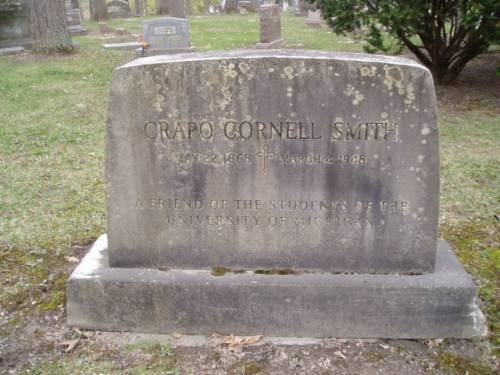
Lucy Anna Crapo married someone she must have known from her childhood in New Bedford (for he was named after her father), Humphrey Henry Howland Crapo Smith, in 1858. They had two children. Henrietta Crapo Smith (the star of our story) was born on July 4th, 1862. Crapo Cornell Smith, her younger brother, who became a lawyer and an eccentric, was born on May 22, 1868 and left $1,000,000 to the University of Michigan for scholarships when he died in 1948.


Photo of the Detroit Museum of Art, E. Jefferson Avenue, from the Burton Historical Collection.
I can only guess at her childhood, for Letta, as she was always known, makes her first appearance in public documents in the photo above. She was around eighteen years old in the photo. Her father managed lumberyards near the waterfront for her grandfather. In Detroit, her extended family of Crapos lived in mansions in the best neighborhoods... in Flint, it was the same. There were large family gatherings at the fourteen hundred acre Crapo Farm. Descendants of Letta's cousins tell stories of summers on the farm, the swimming hole, maple-sugaring, hay wagons, and the largest herd of Hereford cattle in North America. There must have been visits back east to family and friends... perhaps there were visits to her brother and cousins who went to Harvard, like her Uncle William. 


I imagine her being interested in drawing and painting at an early age, and perhaps taking lessons from the best art teacher in town, Julius Melchers, whose son Gari, only two years older than Letta, would go on to play an important role in her development as an artist. Her mother Lucy Anna was an early supporter of the Detroit Museum of Art. The name Mrs. H.H.H. Crapo Smith appears regularly in reports on fundraising and operations for the new museum, including an 1894 annual report.

Her twenties and thirties are somewhat shrouded in mystery. When she was twenty-one, her mother was chair of the committee for acquiring foreign artworks to be loaned to the Detroit Art Loan Exhibition of 1883. It seems clear that she traveled to England, France, Italy, and Holland, studying art and painting during this period, although a record of dates is elusive. Sometime in the 1890's, she studied in Paris at the Academie Julian. She had a picture in the World's Fair of 1893, and in an Art Institute of Chicago show in 1898. Her pictures were shown in the Paris Salon in 1901 and 1902, according to Clarence Burton, and possibly earlier, according to the World's Fair book author and Helen Keep (Helen, as an amateur historian and a meticulous record-keeper, would not have been mistaken about this). In Detroit, Letta studied with Julius Rolshoven and Gari Melchers, in New York, with William Merritt Chase, in Paris, with William Adolphe Bouguereau, in Holland with George Hitchcock. Rolshoven did a pastel portrait of her, catalogued in the family papers at U of M Flint, and mentioned in the card catalog of the Burton Collection.
Below, photo of Letta Crapo Smith's studio, from the Burton Historical Collection
I believe the large painting was exhibited in Paris, and also at the 1893 Chicago World's Fair.
She lived with her parents and bachelor brother at 789 E. Jefferson. Her studio, shown above, was on the top floor. The home no longer stands, but others of the same era give us a glimpse of how it looked. It would have been located between today's University Club and Garden Court Condominiums (neither there in her time), near Chene. Jefferson Avenue was a tree-lined residential street, a mix of new mansions and some of the oldest homes of the city's earliest residents. Letta's friend Helen Elizabeth Keep, a painter and amateur historian, lived nearby at 799 E. Jefferson with her parents in 1885. She would have passed Senator James McMillan's home (where the University Club now stands) on her way downtown.

Photo below of James McMillan residence from the Burton Historical Collection

Here are some details from nearby homes of her day that still stand....
After 1900, her steps become easier to trace. The most clearly documented period of Letta's life is about to begin, revealed by her involvement with the Detroit Society of Women Painters.

She was a founding member in 1903, along with Mary Chase Perry and a bevy of other familiar Detroit names, four years before the Hopkin Club began (which would become the Scarab Club).

From the very first entry in the book of the secretary's minutes:
Photo of the secretary's book of minutes, the Detroit Society of Women Painters, from the Burton Historical Collection, Detroit Public Library
NEXT WEEK: Letta leads the Detroit Society of Women Painters, visits an art colony in Holland, goes to Japan, and a list of her known works.

Other resources for this post:
My thanks to the librarians at the Burton Historical Collection of the Detroit Public Library for their assistance, and to Maria Ketcham at the Detroit Institute of Art's research library. I also learned much from the following publications:
Dutch Utopia:  American Artists in Holland, 1880-1914
  Telfair Museum of Art, 2009, by Annette Stott and Holly Koons McCullough
Artists of Michigan From the Nineteenth Century
  Muskegon Museum of Art, 1987
  Chapter on Letta Crapo Smith, by Annette Stott
History of the Detroit Society of Women Painters
  1953, by Julia Gatlin Moore